Virtual Laboratories: Immersive Apps That Bring Physics and Chemistry to Life
Traditional science education suffers from a profound accessibility gap. It is incredibly difficult to internalize the invisible mechanics of molecular bonding, thermodynamic variables, or electromagnetic fields by staring at a flat, two-dimensional textbook illustration. Worse yet, conducting high-level experiments in a physical laboratory comes with steep barriers: equipment is expensive, chemical reagents can be highly hazardous, and a single mistake can ruin hours of work.
To bridge this educational divide, developers have created sophisticated sandbox environments right on our mobile devices. By pairing rigorous mathematical engines with interactive visual assets, these apps allow users to compress time, visualize atomic frameworks, and trigger volatile chemical reactions entirely risk-free. To find out which tools offer legitimate scientific accuracy rather than simple gamified gimmicks, the top simulation tools on the US market were evaluated. The testing focused heavily on physics engine fidelity, the accuracy of chemical reaction formulas, touch-control responsiveness, and real-world educational value.
The following interactive toolkits represent the absolute best platforms for turning a smartphone or tablet into a fully functioning digital science lab.
PhET Simulations
Availability: iOS, Android, Web
Pricing Model: Completely free access via web browsers; standalone mobile apps for offline use are a one-time purchase of $0.99.
The Reality Check
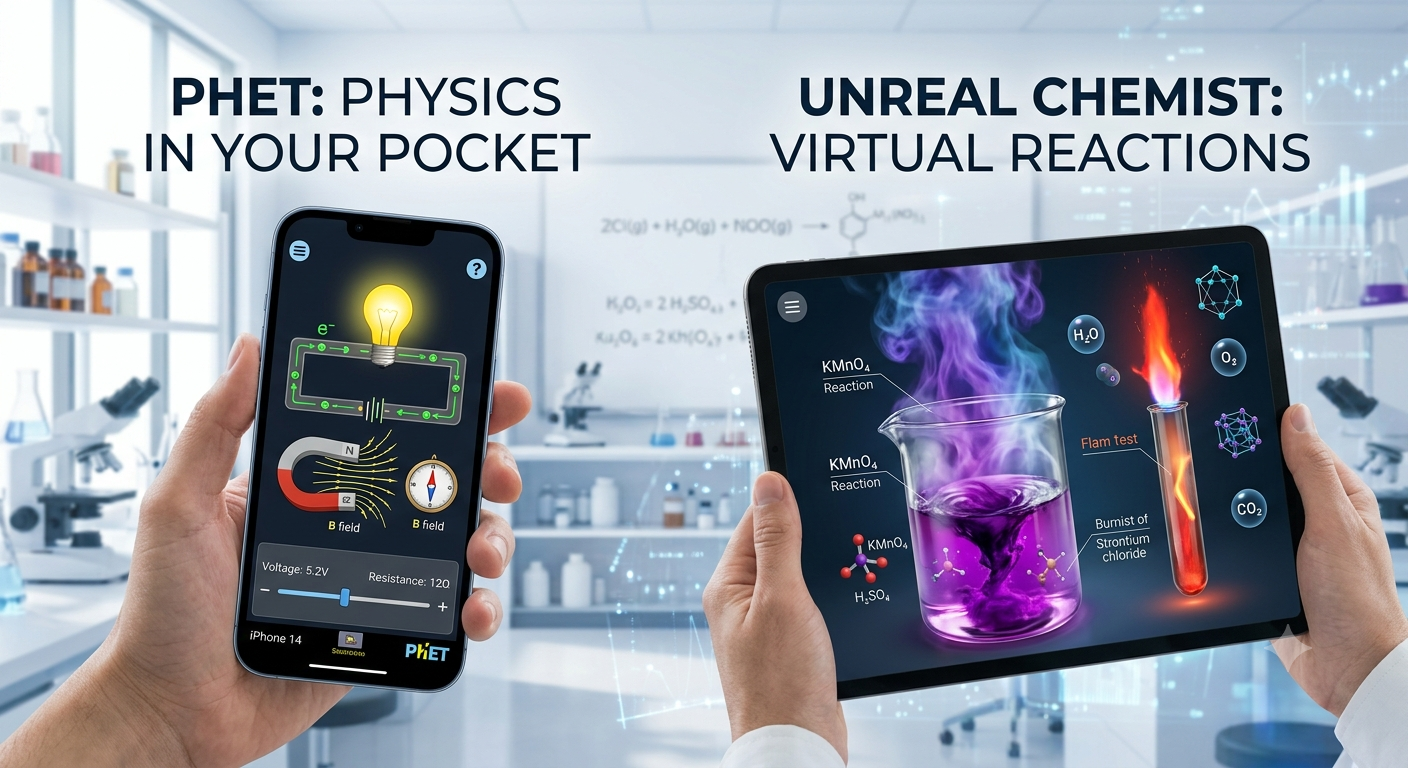
Developed by the University of Colorado Boulder, PhET Simulations is an absolute heavyweight in the STEM education space. When we loaded the mobile interface to test complex fluid dynamics, greenhouse gas absorption, and quantum atomic models, its research-backed design was immediately apparent. The app provides an open-ended, highly academic sandbox.
For instance, when manipulating the "Circuit Construction Kit," you aren't just dragging cartoon graphics around; you are actively measuring realistic voltage drops and electron currents using fully functional virtual voltmeters and ammeters. It strips away all gamified fluff, providing raw, interactive control sliders that show users exactly how changing an independent variable—like increasing gas pressure or adjusting a magnetic field—instantly impacts a system in real time.
Pros & Cons
Pros: Unmatched academic rigor across a massive library covering physics, chemistry, thermodynamics, and quantum mechanics. Complete offline usability with zero data tracking, hidden paywalls, or distracting advertisements.
Cons: The user interface is strictly functional and lacks modern aesthetic Polish, resembling an academic web portal rather than a cutting-edge mobile app. There are no built-in step-by-step tutorial sequences, which can leave independent learners feeling lost without a teacher's guided lesson plan.
Unreal Chemist
Pricing Model: Free base download; Pro version upgrade available via a one-time in-app purchase of $5.99.
The Reality Check
Unreal Chemist transforms your screen into a high-fidelity, visually stunning chemical reaction chamber. When we tested the platform by mixing various volatile compounds, we were highly impressed by the visual rendering of real-world chemical physics. The app allows you to adjust concentration levels, regulate ambient temperatures, and drop indicators to watch distinct pH changes occur in real time.
The absolute standout feature is the realistic graphic engine: when you burn specific metal salts, the app renders distinct, chemically accurate colored flames and precipitation solubility effects. It is an incredible playground for running hyper-dangerous experiments—like mixing superacids or triggering heavy exothermic combustions—that would be impossible to conduct safely in a standard physical space.
Pros & Cons
Pros: Gorgeous 3D visual fidelity with highly accurate renders of flame tests, gaseous discharges, and precipitation colors. Includes a highly practical built-in chemical equation balancer to help synthesize laboratory steps.
Cons: While the database features over 150 unique chemicals, some highly complex organic chemistry reactions are not yet fully simulated or remain purely theoretical. Free users face restricted access to advanced reagents and specific precision lab tools.
BEAKER by THIX
Availability: iOS
Pricing Model: Retails for $0.99 to $1.99 upfront depending on the platform store, with all secondary tools completely unlocked for free.
The Reality Check
BEAKER relies on a brilliant, highly minimalist hardware concept: it turns your entire smartphone screen into a physical glass beaker. The app uses your device's internal accelerometer to handle virtual liquids, solids, and gases. When we tested the app by adding pieces of pure lithium into virtual water, we could physically tilt, swirl, and shake the phone to accelerate the reaction, watching the simulated liquid slosh accurately against the sides of the screen.
Another exceptional feature is "AirMix," which utilizes local wireless connectivity to let you position two different devices side-by-side. You can physically "pour" chemicals from one smartphone screen directly into another, creating an incredibly interactive collaborative lab space.
Pros & Cons
Pros: An incredibly intuitive tactile interface that uses hardware sensors to make chemistry feel physical and organic. The AirMix multi-device functionality is an absolute triumph for collaborative group learning.
Cons: The application lacks a deep dataset of instructional context or raw mathematical readouts; you see the visual reaction take place, but you don't get granular molecular breakdowns or active data charts. The asset library hasn't seen a major feature update in several cycles.

The Final Verdict
Selecting the premier simulation app requires identifying how you naturally process scientific information:
If your primary objective is to interact with chemical compounds in a highly visceral, artistic way, BEAKER by THIX offers a beautifully tactile and clever interface. For those looking to master high-school or college-level chemistry lab requirements through jaw-dropping 3D visual renders and color-accurate flame reactions, Unreal Chemist delivers a highly satisfying, premium experience.
However, for comprehensive scientific inquiry across both physics and chemistry disciplines, PhET Simulations remains the undisputed gold standard. Backed by rigorous university educational research, its uncompromising focus on variables, measurement tools, and mathematical integrity ensures it provides the deepest cognitive value. It transitions mobile devices from mere media players into formidable, active testing facilities for complex scientific principles.