Tracking the Burn: 4 Essential Apps to Manage Sun Exposure and UV Index in 2026
The sun is deceptive. A crisp, 65-degree spring morning in Denver can expose your skin to more damaging ultraviolet (UV) radiation than a humid, 85-degree afternoon in Miami, thanks to higher altitudes and shifting atmospheric layers. Relying purely on sensory temperature or basic weather apps to gauge sun protection is a fast track to premature skin aging and painful burns.
To take the guesswork out of sun safety, specialized UV tracking applications have evolved significantly. They no longer just display a static number from 1 to 11; modern trackers factor in your exact geographic coordinates, personal skin type, and even real-time physical posture to calculate precise burn risks.
We spent weeks testing the leading sun safety software on both iOS and Android across various US microclimates—from the glaring high-altitude sunshine of Colorado to the coastal humidity of Southern California. Our testing focused on four core criteria: real-time hyper-local data accuracy, the practicality of sunscreen reapplication reminders, user interface clarity, and data transparency. Here are the four applications that earned a spot on our devices.
UVLens (iOS and Android)
Developed by ElementX Limited, UVLens is designed with a singular, clear objective: to tell you exactly when it is safe to be outside and when you need to cover up. Following a comprehensive rebuild of its core engine, the 2026 version offers a highly stable, completely ad-free experience that prioritizes streamlined data over unnecessary feature bloat.
The Reality Check
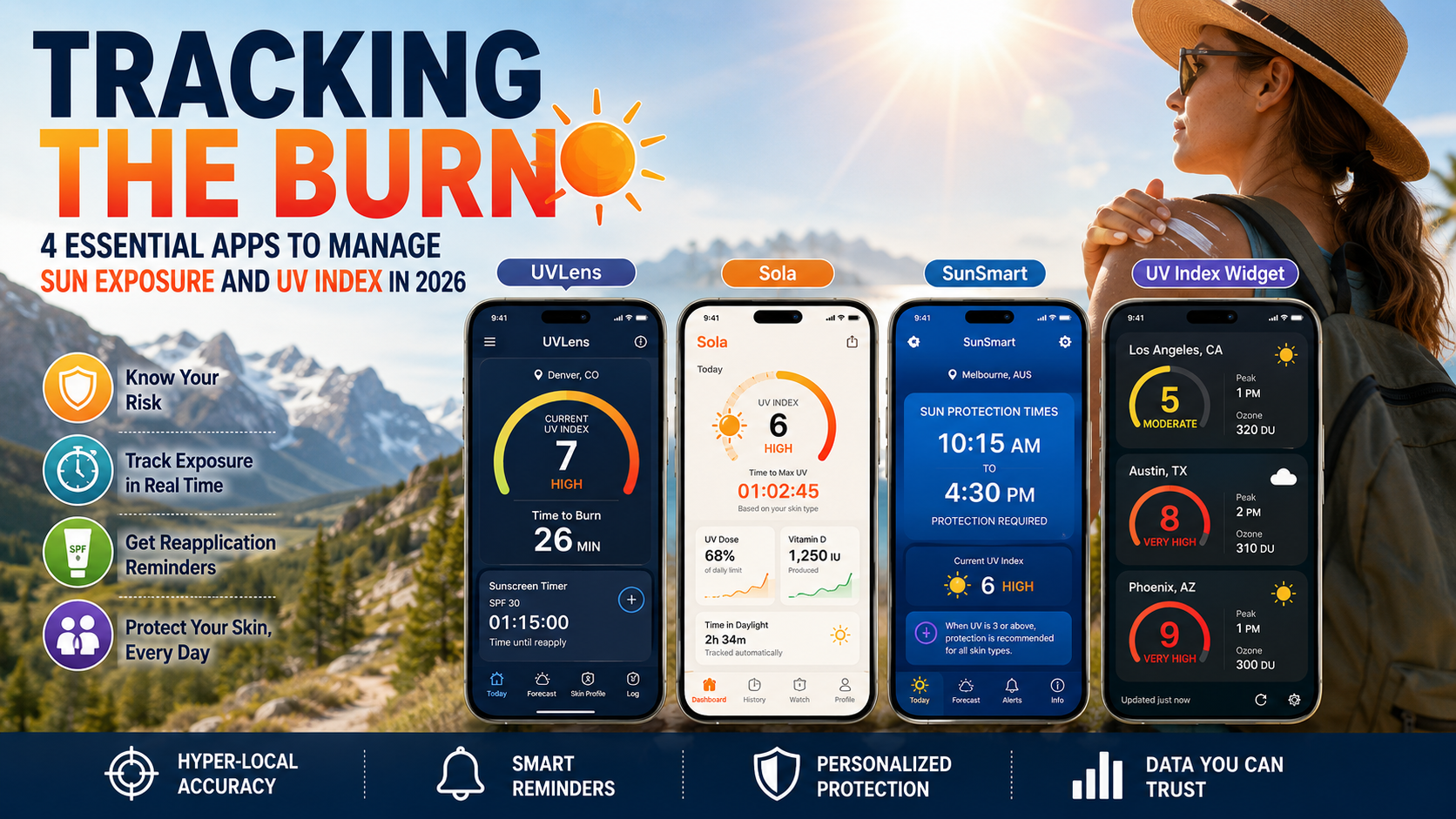
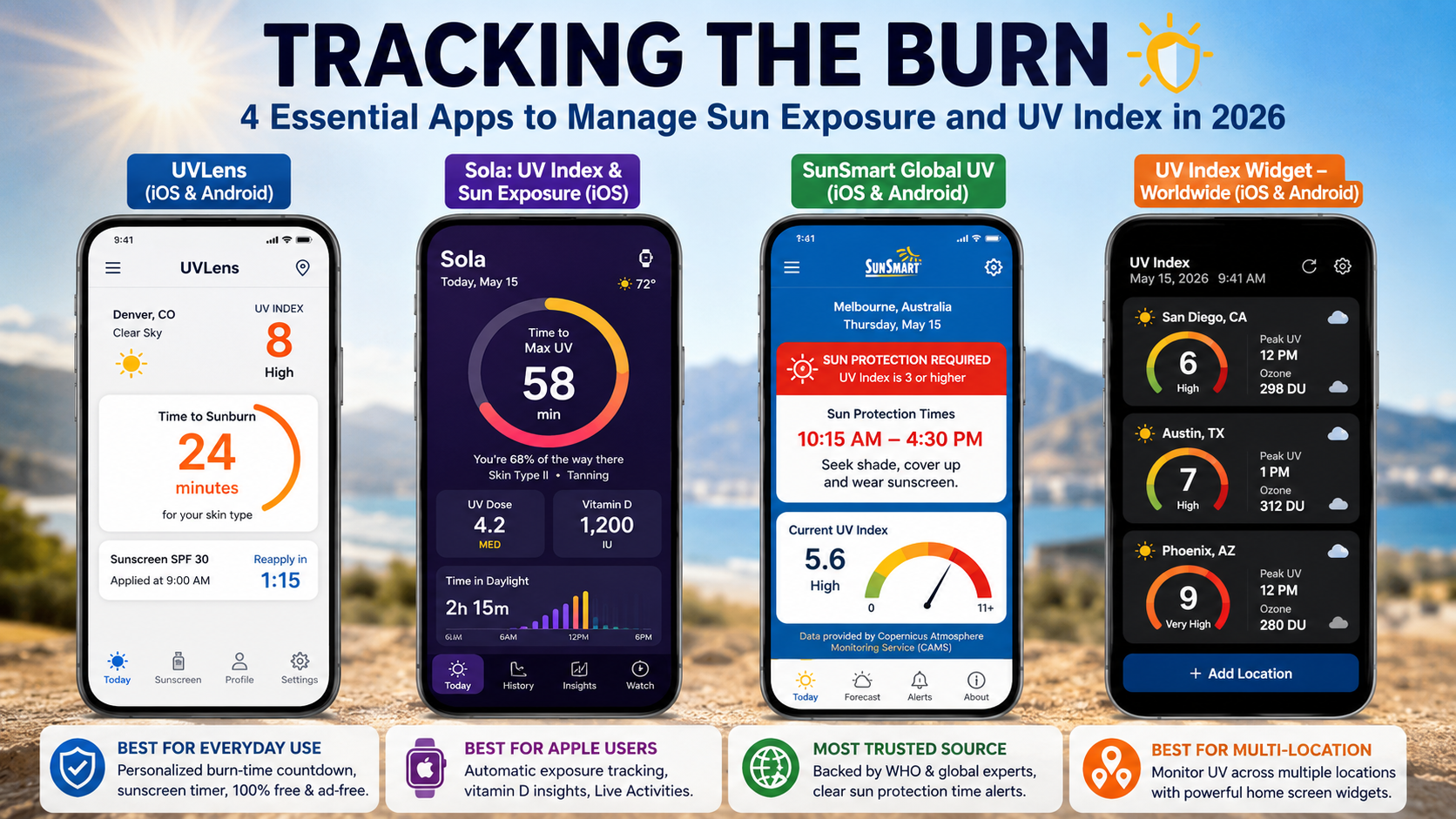
The standout feature of UVLens is its highly functional Skin Profile Assessment. When we first launched the app, it walked us through a series of personalized questions regarding eye color, natural skin tone, and genetic tendencies to burn or tan. Instead of presenting an abstract UV number, the home screen translates the current forecast into a tangible countdown: exactly how many minutes you can spend outside before a sunburn begins to set in. The built-in sunscreen timer is also exceptionally reliable, allowing us to log an application of SPF 30 and receiving an alert precisely when the formula's protective threshold dropped.
Pros & Cons
Pros:
100% free with absolutely no distracting advertisements or hidden premium paywalls.
Personalized burn-time countdown adjusts dynamically as hourly UV levels fluctuate.
Allows users to manually set an explicit location rather than forcing constant background GPS tracking.
Cons:
The user interface, while incredibly clean, lacks advanced graphical overlays or historical exposure mapping.
Sunscreen logs are basic and do not account for swimming or heavy sweating variables.
Sola: UV Index & Sun Exposure (iOS)
BrightMatter LLC’s Sola is a premium, beautifully crafted health utility tailored for individuals who want an granular look at their sun metrics. Rather than just viewing the current atmospheric state, Sola treats your skin like a bank account, calculating your cumulative UV dose and tracking exactly how much vitamin D your body synthesized throughout the day.
The Reality Check
Sola’s killer feature is its automated Time in Daylight tracking via the Apple Watch's ambient light sensors. When we wore our watch outside, Sola automatically registered our sun exposure without requiring us to manually start a session. On the iPhone, its Live Activities and Dynamic Island integration are masterfully executed. While lounging outdoors, our lock screen displayed a real-time, ticking countdown indicating exactly how close we were to reaching our maximum safe UV threshold based on our skin type and whether we were actively flipping to tan or staying static.
Pros & Cons
Pros:
Seamless Apple Watch integration that tracks actual light exposure passively.
Advanced scientific formulas that estimate vitamin D synthesis alongside UV damage.
Live Activities support keeps critical timers accessible at a glance on your Lock Screen.
Cons:
Strictly exclusive to the iOS ecosystem; no Android version exists.
The free tier is highly restrictive, requiring a subscription ($3.99/month, $12.99/year) or a steep $39.99 lifetime purchase to unlock core automated tracking.
SunSmart Global UV (iOS and Android)
If you want absolute, institutional authority without commercial influence, SunSmart Global UV is the gold standard. Developed by Cancer Council Victoria and backed directly by a coalition including the World Health Organization (WHO) and the World Meteorological Organization (WMO), this app is designed strictly as a public health intervention tool to combat skin cancer.
The Reality Check
SunSmart rejects the typical "safe tanning" marketing of commercial apps. Instead, its core mechanism revolves around Sun Protection Times. The app utilizes global meteorological data fed directly from the Copernicus Atmosphere Monitoring Service. The moment the local UV index hits 3 or higher—the internationally recognized threshold where skin cell damage accelerates—the app transitions into a high-visibility alert state. It explicitly maps out the exact block of hours (e.g., 10:15 AM to 4:30 PM) during which sun protection is mandatory, eliminating the ambiguity of checking fluctuating hourly numbers.
Pros & Cons
Pros:
Backed by verified, world-leading health organizations with zero corporate data-mining.
Provides clear, unambiguous time brackets dictating exactly when protection is required.
Features highly customizable weather alert thresholds for extreme UV spikes.
Cons:
The app does not feature an accompanying home screen widget for quick glances.
Completely lacks localized features like tracking specific sunscreen types or personal skin-aging metrics.
UV Index Widget - Worldwide (iOS and Android)
Created by independent developer Bjorn Jenssen, this application is engineered explicitly for users who want to monitor atmospheric radiation across multiple US regions instantly without constantly digging through app menus. It acts as an information dashboard optimized for home screen real estate.
The Reality Check
The Multi-Location Widget Array is where this app beats every competitor. We configured our iOS home screen with three separate medium-sized widgets: one for our current location in Southern California, one for a family member in Texas, and one for a planned travel destination in Arizona. The widgets refreshed reliably in the background, utilizing clear color-coded dials to display the current UV level, the daily peak hour, and localized ozone layer thickness. If you manage outdoor teams or have family members scattered across distinct climate zones, this app provides unparalleled geographical oversight.
Pros & Cons
Pros:
The most comprehensive and visually diverse collection of home screen widgets on the market.
Provides specialized atmospheric data, including local ozone thickness and cloud coverage impact.
Offers an affordable lifetime premium purchase option for users avoiding recurring subscriptions.
Cons:
The free version is heavily supported by disruptive ads that clutter the bottom of the main interface.
We encountered occasional location sync delays when moving quickly between different microclimates.
The Final Verdict
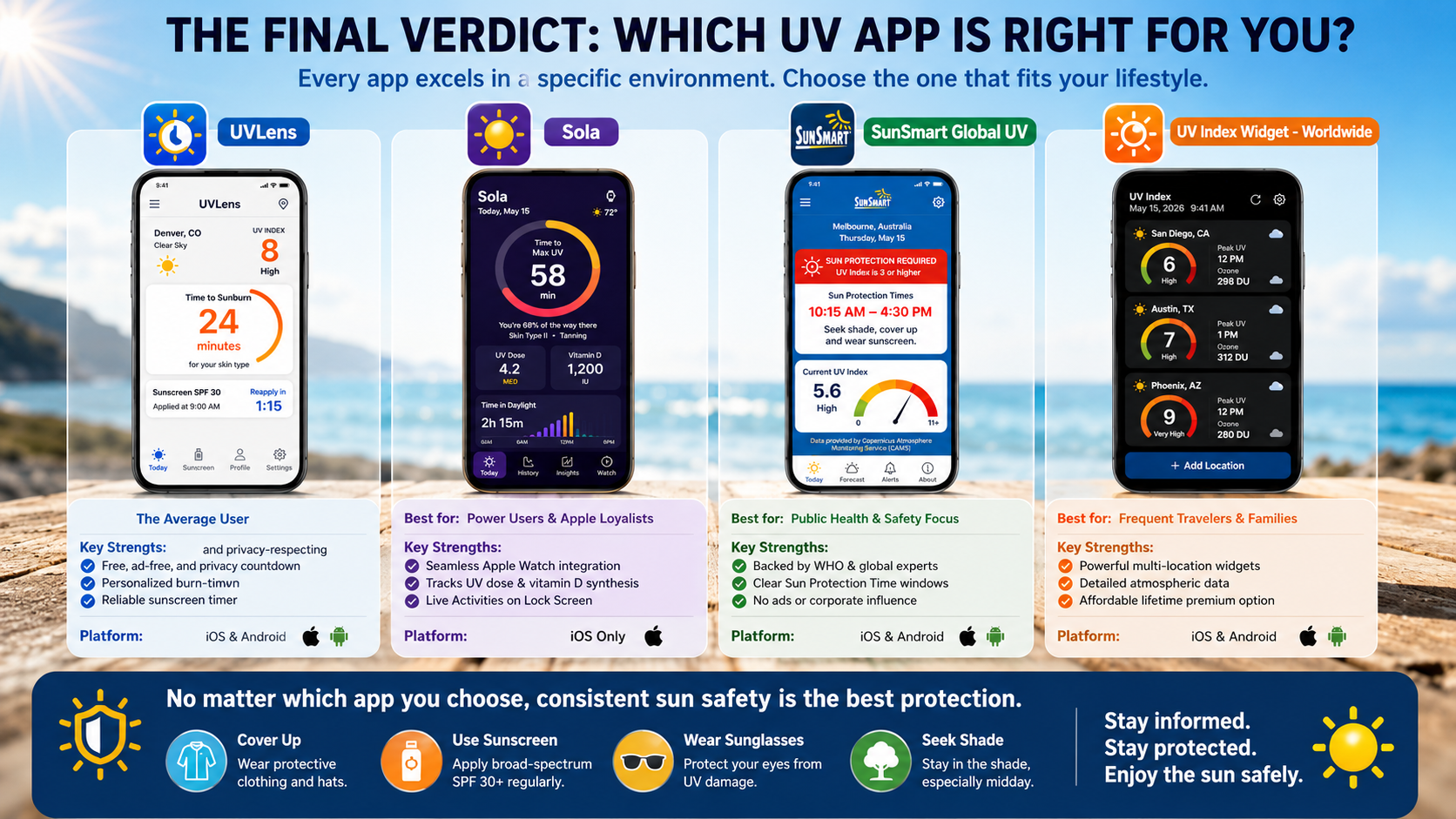
Every app featured here excels in a specific environment, but the absolute best choice depends entirely on your daily routine and platform preference.
For the Average User (Best Overall): UVLens
If you want an app that tells you exactly when you will burn, tracks your sunscreen, costs absolutely nothing, and respects your privacy with an ad-free interface, UVLens is the unrivaled winner for both iOS and Android. Its minimalist design and practical minute-by-minute countdown make it an essential daily health utility.
For Power Users & Apple Loyalists: Sola
If you are deeply invested in the Apple ecosystem and want to leverage your hardware to track cumulative UV doses and vitamin D synthesis automatically, Sola is well worth the premium subscription price.
For Frequent Travelers & Families: UV Index Widget - Worldwide
If your primary goal is to keep an eye on shifting radiation levels across multiple regional coordinates across the United States at a single glance, UV Index Widget - Worldwide provides the most robust desktop dashboard functionality available.