Time Travel in Your Pocket: The Ultimate Interactive Tools for History Enthusiasts
For true history buffs, textbooks and Wikipedia articles often fall short. Reading a flat block of text about the shifting borders of the Roman Empire or the architectural layout of ancient Egyptian temples can feel completely uninspired. The challenge isn't a lack of interest; it's a lack of context. History is spatial, visual, and deeply interconnected, yet most digital tools treat it like a static memorization game.
To find out which platforms successfully bridge the gap between academic data and immersive exploration, our team spent weeks field-testing the leading historical applications available on the US Apple App Store and Google Play Store. We judged them on three rigorous parameters: geological and chronological accuracy, interface fluidness when manipulating massive datasets, and the quality of their interactive elements.
Here is the unfiltered reality of the three interactive mobile tools that truly bring the past to life.
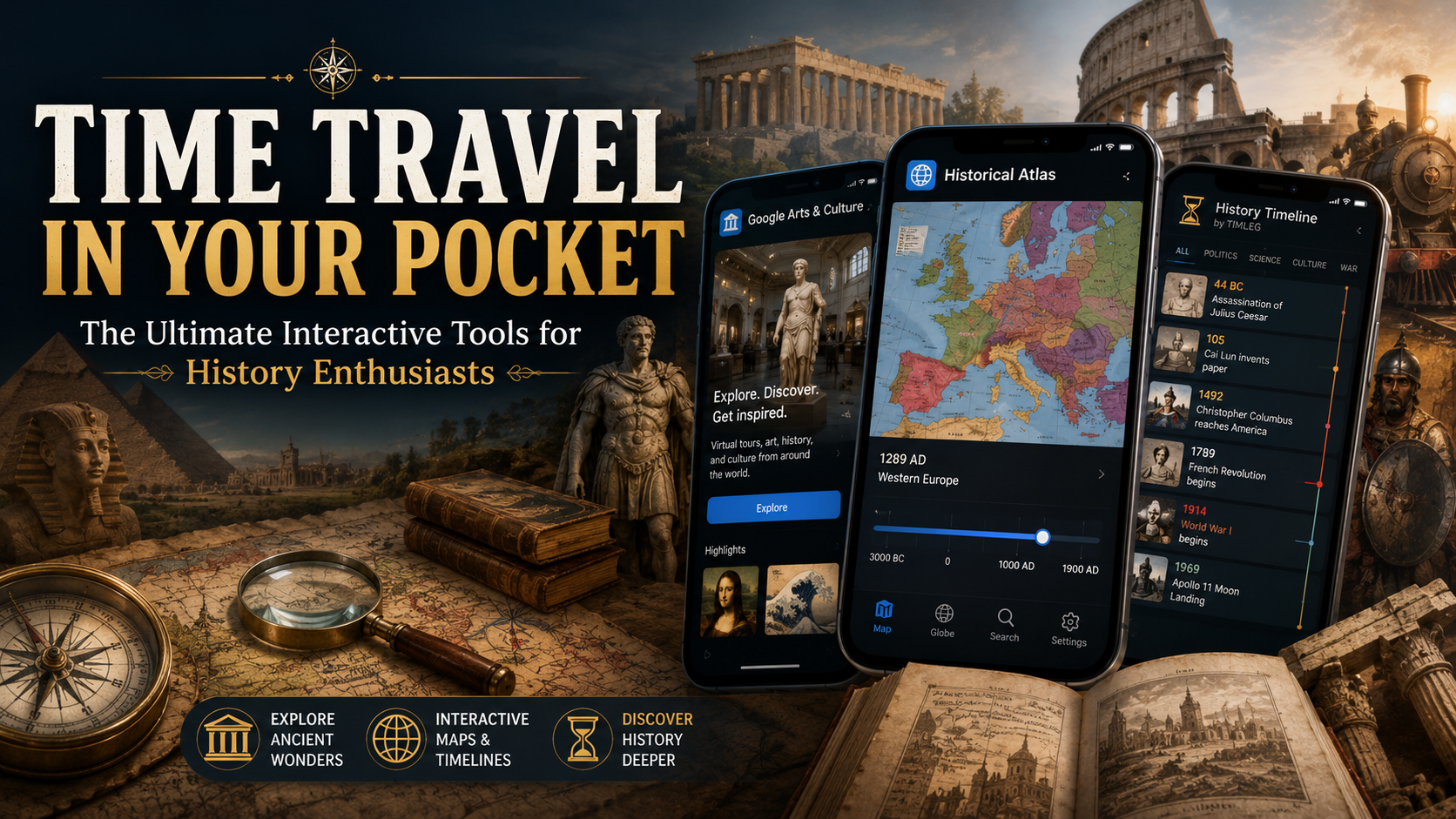
Google Arts & Culture (iOS / Android)
Maintained by the Google Cultural Institute, this app partners with over 2,000 museums and archives globally to place millions of artifacts, historical documents, and high-resolution virtual tours directly onto your smartphone.
The Reality Check
When we opened Google Arts & Culture, the sheer scale of the engineering took us by surprise. This is not a basic image gallery. The absolute standout feature is its "Pocket Gallery" and augmented reality (AR) museum walkthroughs.
During our testing sessions, we were able to project a life-sized, virtual gallery into a room and walk through it using our phone's camera, examining historical masterpieces and artifacts down to individual brushstrokes and microscopic cracks. The app's integrated timeline features let you select an era and view what artists, politicians, and common citizens were creating or experiencing concurrently across different hemispheres. It successfully solves the "silo problem" of history by visually connecting global events that happened at the exact same moment.
Pros & Cons
Pro: Absolutely massive database backed by official partnerships with the world's leading archival institutions.
Pro: Stunning AR features and 360-degree street view integration let you explore historical sites like Pompeii natively.
Pro: Completely free of charge with zero advertising or hidden paywalls.
Con: The user interface is so packed with content that it can feel incredibly overwhelming to navigate.
Con: It functions more as an exploratory museum network than a structured chronological history textbook.
Pricing Model
Free Tier: 100% Free.
Historical Atlas (iOS)
Developed by Jododdle Co., Ltd., Historical Atlas is an interactive, dynamic world map designed to show 5,000 years of global human civilization tracking year-by-year from 3000 BC to 1900 AD.
The Reality Check
When we put Historical Atlas through its paces, we focused heavily on its core mechanism: a smooth chronological slider at the bottom of a detailed globe. As you drag your thumb across the centuries, you watch empires swell, borders shatter, and colonial expansions sweep across continents in real time.
The feature that genuinely works is the "Movie Mode" and the newly updated manual date entry block. If you want to see exactly who held land in Western Europe in 1289, you type it in, and the map instantly realigns with precise regional data, listing specific capitals, fortifications, and strategic post roads. However, during our testing, a major structural limitation emerged: the data abruptly cuts off at the year 1900. If you are hoping to track the complex border shifts of World War I, World War II, or the Cold War, you are entirely out of luck until the developers push future updates.
Pros & Cons
Pro: Flawless visual representation of how territories and borders evolved dynamically across 5,000 years.
Pro: Deep granular map toggle settings for tracking ancient canals, railways, and the Great Wall.
Pro: Features a smooth "globe" projection view that offers highly accurate spatial and distance perspectives.
Con: The historical timeline leaves an empty gap for the 20th and 21st centuries.
Con: The app is exclusively built for iOS, leaving Android users completely sidelined.
Pricing Model
Free Tier: Basic download with partial map and era restrictions.
In-App Purchases: Offers tiered lifetime or pro unlocks ranging around $3.99 to $9.99 for unrestricted full access to the chronological maps.
History Timeline by TIMLEG (Android)
History Timeline provides a comprehensive, fully scrollable micro-to-macro timeline of world history, packing thousands of hyper-filtered entries ranging from ancient evolutionary events to 21st-century milestones.
The Reality Check
Testing History Timeline on an Android device quickly highlighted its value as a pure comparative research engine. The platform uses a unique 25-step zoom system. You can zoom out all the way to view centuries as small tick marks, or pinch-to-zoom inward to isolate a specific single month.
The core feature that makes this app an indispensable tool is its cross-referencing filtering system. For instance, when we isolated a 100-year window, we could apply filters to view what was happening in science, music, philosophy, and military warfare simultaneously. Every single event card links seamlessly directly to verified historical databases and Wikipedia for deep-dive reading. The interface isn't flashy, and it certainly won't win any graphic design awards, but as a dense, lightning-fast reference index for data sorting, it performs exceptionally well.
Pros & Cons
Pro: Unmatched zoom features allow you to seamlessly jump from deep geologic time scales down to exact dates.
Pro: Powerful filters let you isolate specific categories like "Leaders" or "Art" across specific geographical regions.
Pro: Allows users to build, edit, and export their own custom historical event lists.
Con: The visual design feels heavily dated and utilitarian compared to modern, sleek app styles.
Con: The sheer quantity of unorganized text entries within deeply stacked lists can cause reading fatigue.
Pricing Model
Free Tier: Ad-supported access to the complete timeline dataset.
Premium Version: Available for a one-time payment of roughly $2.99 (or included via Google Play Pass) to completely remove advertisements.
The Final Verdict
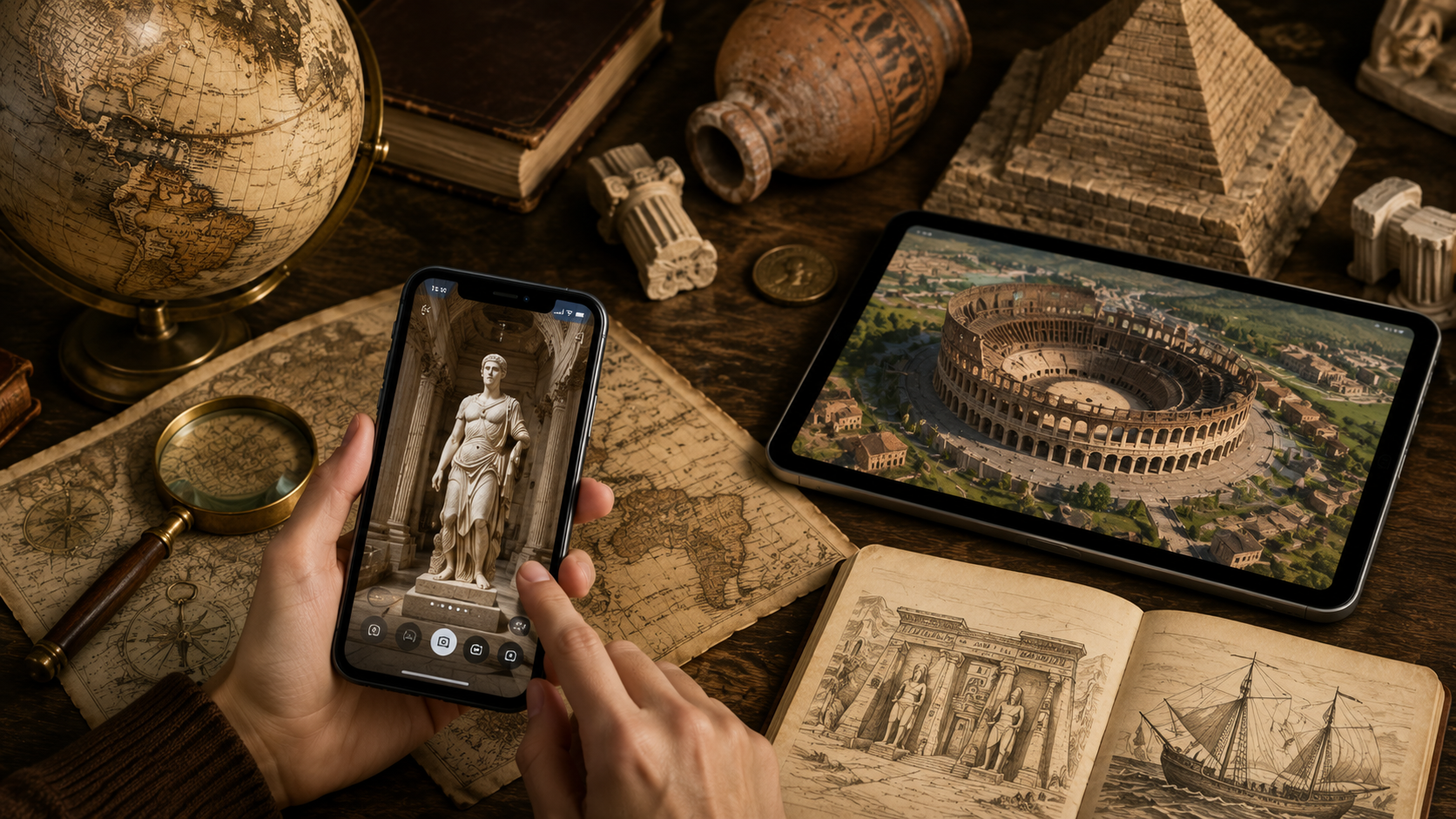
After extensive testing across different interfaces, layouts, and operating systems, we concluded that the absolute best tool depends entirely on your specific learning style.
For individuals seeking a premium visual experience where you can watch the physical landscape of human civilization shift geographically over thousands of years, Historical Atlas is an incredible achievement for iOS users. If your goal is cross-referencing data and mapping out exactly what philosophers in Asia were writing while European kingdoms were fighting wars, History Timeline provides the best analytical framework on the market.
However, for the vast majority of history enthusiasts, Google Arts & Culture takes the crown. Its unparalleled combinations of museum archive depth, interactive AR walkthroughs, and zero financial barriers make it the most impressive, comprehensive portal to the past available on a mobile phone today.