Sharpness Over Speed: Training the Analytical Mind with Mental Math and Logic Platforms
Pulling out a smartphone to split a restaurant check or calculate a basic percentage has become a societal reflex. While digital calculation engines offer immediate convenience, relying on them continuously can lead to a form of cognitive rust. The neural pathways responsible for rapid quantitative reasoning, pattern recognition, and structured logical deduction require consistent, active engagement.
However, searching mobile application storefronts for genuine cognitive training software reveals significant market noise. The ecosystem is heavily saturated with low-budget cloning efforts—specifically dull arithmetic drill grids that mimic old school worksheets, or "brain training" suites that prioritize flashing casino-like animations over substantive cognitive metrics. When evaluating tools for this digital testing suite, several strict benchmarks were enforced: the educational depth of the underlying algorithms, raw interface responsiveness, progressive difficulty scaling, and a lack of highly disruptive, unskippable advertisement formatting.
After weeks of calculating, tracking down hidden numerical sequences, and dissecting visual logic grids on the go, three distinct applications proved they offer genuine cognitive value.
Elevate
OS Availability: iOS, Android
Elevate approaches brain training from a highly practical, communication-focused angle. Instead of limiting its modules to abstract geometric shapes or isolated math grids, it embeds arithmetic and logical reasoning directly into everyday professional skills like editing, reading comprehension, and financial estimating.
The Reality Check
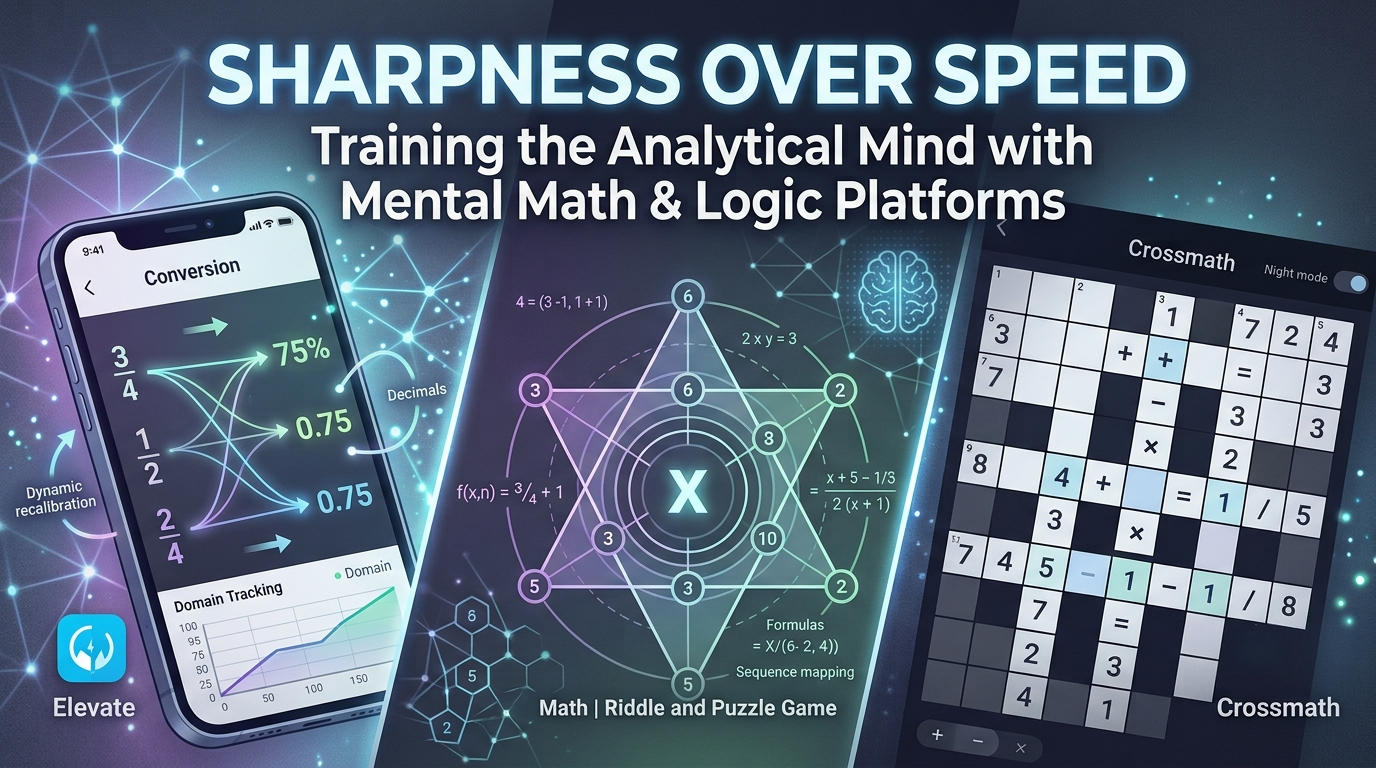
The "Memory" and "Agility" math modules deliver remarkably effective instructional design. When we tested games like Conversion (which forces rapid switching between fractions, percentages, and decimals) or Discount (calculating retail markdowns under a strict countdown timer), the app did not feel like a passive pop quiz. It uses a clean, highly stylized typographic design that trains users to isolate numerical priorities instantly. The application accurately tracks performance using an internal metrics baseline called the Elevate Proficiency Measure (EPM), dynamically adjusting the processing speed and numerical complexity of the next round based on your response latency.
Pros
Highly Practical Contextualization: Math games focus heavily on real-world utility, such as tax calculation, tipping, and data estimation.
Masterful Adaptive Difficulty: The internal pacing algorithm recalibrates seamlessly, avoiding sudden walls of impossible complexity.
Deep Analytical Dashboards: Provides detailed tracking across five specific cognitive domains, mapping out daily progress with transparent historical data charts.
Cons
Premium Financial Gatekeeping: Access to the complete, unfiltered suite of over 40 games requires an annual subscription of roughly $44.99 (or $4.99/month), heavily restricting the trial-tier experience.
Broader Focus: If your goal is purely pure mathematical proofing or advanced symbolic logic, you may find the word- and reading-heavy games a bit distracting.
Math | Riddle and Puzzle Game
OS Availability: iOS, Android (Developed by BlackGames)
For those who want to completely bypass text-heavy reading games in favor of pure, uncompromising analytical problem-solving, this application operates like a highly structured IQ exam hidden inside an arcade interface.
The Reality Check
The geometric pattern-recognition engine is brilliant. Rather than presenting basic equations like $12 \times 14$, the app drops you into complex geometric structures—such as concentric circles, intersecting triangles, or relational grids—where numbers are placed at specific vertices. Your task is to identify the underlying algebraic formula governing the shape to find the missing variable. When testing these levels during a noisy afternoon commute, the absolute silence of the app's interface became its greatest asset. There are no flashing graphics or timer bars to cause panic; it forces deep, meditative spatial and quantitative analysis.
Pros
Deep Cognitive Rigor: Successfully challenges lateral thinking, sequence mapping, and algebraic logic rather than just rote memorization.
Minimalist Interface Layout: Stark, distraction-free visual presentation that respects the user's focus.
100% Free Entry Path: The entire multi-level puzzle progression can be unlocked and solved without an upfront financial paywall.
Cons
Aggressive Ad Implementation: Because the monetization framework relies on ads, you are forced to sit through video clips between levels or when requesting hints.
Unforgiving Hint Systems: If you find yourself completely stuck on a complex pattern, the game requires you to watch a promotional video just to view a single instructional step.
Crossmath (Math Puzzle Games)
OS Availability: iOS, Android (Published by Guru Puzzle Game)
If you love traditional crossword structures but want to completely swap out language clues for mathematical operations, Crossmath blends Sudoku-style grid positioning with rapid mental math execution.
The Reality Check
The "Expert Mode" grid mechanics function flawlessly as a logical puzzle engine. The application generates a classic grid layout where intersecting rows and columns must form valid equations using addition, subtraction, multiplication, and division. What makes the gameplay challenging is the strict enforcement of standard order of operations ($PEMDAS$). When testing an advanced grid layout, you cannot simply solve left-to-right; you have to mentally isolate multiplication cells first, cross-reference their factors against intersecting vertical columns, and back-fill the remaining operators.
Pros
Superb Order-of-Operations Training: Forces players to instinctively apply correct mathematical precedence rules under pressure.
Excellent Quality of Life Settings: Features large font scaling, clean night modes, and an infinite "Undo" button loop that makes mobile entry smooth.
Vast Difficulty Variance: Scales cleanly from basic 3x3 grids for introductory practice up to massive, multi-tiered arithmetic mazes.
Cons
Post-Level Ad Friction: Free users are met with unskippable ad pop-ups upon completing a grid, which can disrupt the rhythmic flow of back-to-back puzzle solving.
Repetitive Core Loop: The underlying gameplay loop doesn't change drastically across levels; the grids simply get larger and the numbers more complex.

The Final Verdict
Your selection in this category should align precisely with how you prefer to challenge your brain:
For individuals seeking a structured, daily self-improvement routine that blends rapid real-world math with professional communication skills, Elevate remains the absolute gold standard of the brain-training market. Its sleek interface and highly adaptive algorithm easily justify the premium membership cost.
If you are a purist who completely rejects text-heavy filler and wants to test your raw mathematical IQ through deep pattern recognition, Math | Riddle and Puzzle Game provides an unmatched suite of visual mind-benders for free.
Finally, for the casual puzzle enthusiast looking for a highly engaging alternative to standard word games during short breaks, the arithmetic grid architecture of Crossmath delivers an ideal, logic-driven daily workout.