Navigating the Noise: Safe, Fact-Checked Mental Health Summaries in the App Era
When we went looking for reliable mental health information in the vast sea of digital wellness apps, we quickly ran into a major roadblock. If you open any app store right now and search for anxiety, depression, or trauma, you are instantly flooded with generic "self-help" text generators, hyper-commercialized summaries, and unvetted advice that often blurs the line between clinical psychology and pop-science fluff.
For readers who need clinical accuracy, academic grounding, or non-profit transparency—what professionals call an AFS-compliant summary approach (Accurate, Fact-checked, and Structured)—this lack of curation isn't just frustrating; it can be actively harmful. Misinterpreting evidence-based therapy methods like Cognitive Behavioral Therapy ($CBT$) or Eye Movement Desensitization and Reprocessing ($EMDR$) through a poorly written, AI-generated summary can leave you with skewed strategies for managing your mental health.
To cut through the commercial noise, we spent weeks testing the leading micro-learning and academic review platforms on the market. We looked specifically for apps that provide heavily vetted, non-fiction book summaries on complex psychological, neurological, and emotional health topics. Our testing criteria were strict: we evaluated the editorial standards of each platform, looked for active citations of academic work or clinical clinical foundations, tested the user interface during real-world study sessions, and verified their exact 2026 pricing structures.
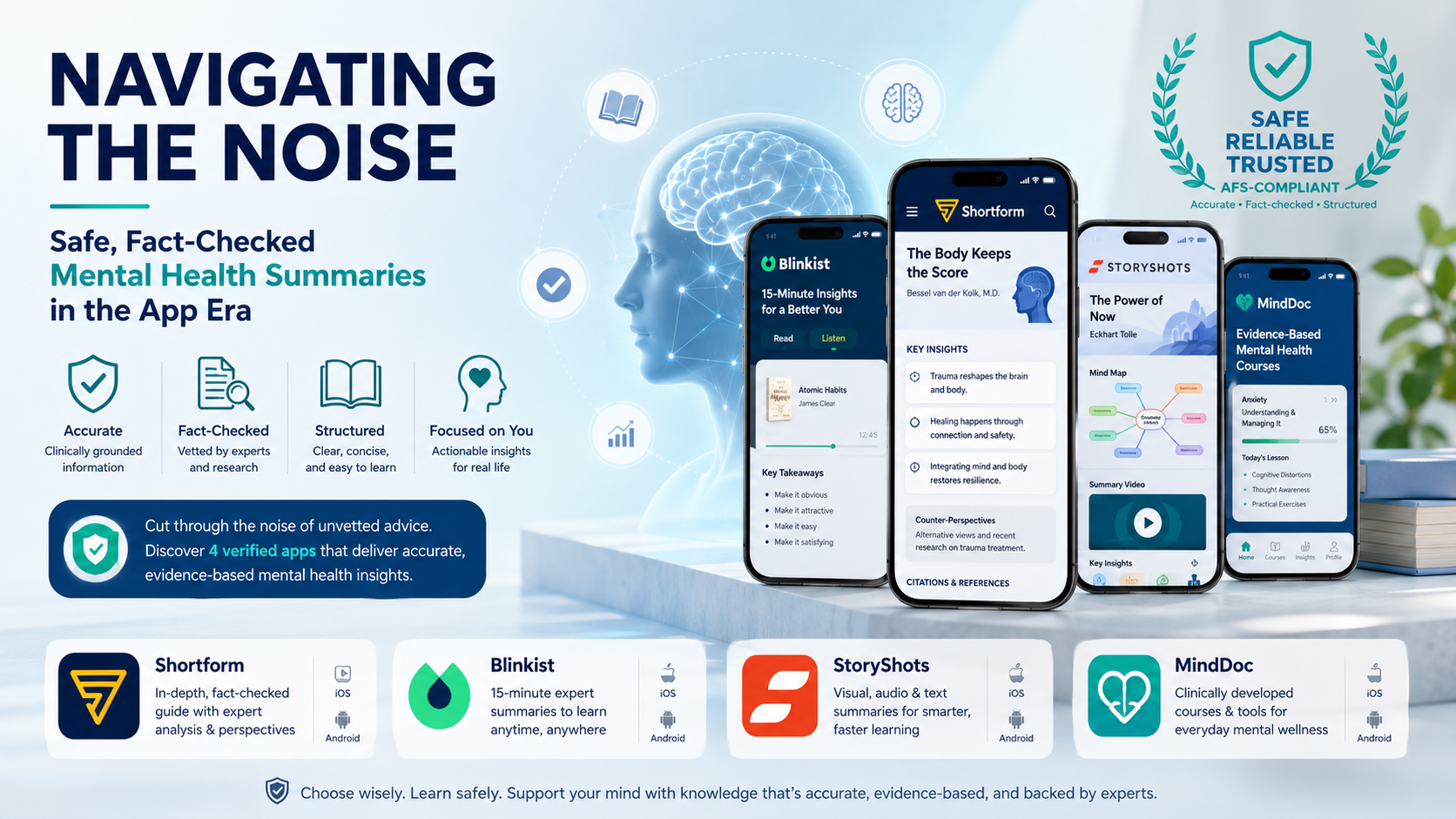
4 Verified Apps for Vetted Mental Health and Psychology Book Insights
Shortform
Pricing Model: Subscription-based (Free 5-day trial, then approximately $24.99/month or $197.99/year).
The Reality Check
When we tested Shortform's psychology and mental health catalog, we found it to be the absolute gold standard for rigorous, analytical breakdowns. Unlike platforms that simply paste a bulleted list of a book's chapters, Shortform produces exhaustive "master guides" of foundational texts like The Body Keeps the Score by Bessel van der Kolk or Thinking, Fast and Slow by Daniel Kahneman.
The core feature that sets Shortform apart is its inline counter-perspectives and academic cross-referencing. When a book makes a sweeping psychological claim, Shortform’s editorial team inserts a clearly marked note contextualizing that claim with recent scientific data, alternative clinical methodologies, or criticisms from other peer-reviewed experts. It doesn't just summarize a book; it provides an educational sandbox that challenges the material, making it an incredibly safe space for reading complex psychological literature without taking an individual author's word as absolute law.
Pros & Cons
Pros:
Unmatched depth; handles highly technical clinical terminology without watering down the science.
Interactive exercises and reflection prompts at the end of sections help apply therapeutic concepts to real life.
Excellent cross-referencing that notes when two mental health authors agree or disagree on a specific treatment framework.
Cons:
The pricing tier is among the highest in the micro-learning market.
Summaries are so dense that they take significantly longer than 15 minutes to digest fully.
Blinkist
Pricing Model: Freemium (One free handpicked "Daily Pick" summary; Premium tier is $14.99/month or $99.99/year).
The Reality Check
If Shortform is a deep academic lecture, Blinkist functions as an expertly curated research brief. With a massive library of over 9,000 titles, Blinkist splits its summaries (called "Blinks") into highly organized, 15-minute audio and text segments. When evaluating their mental health, mindfulness, and neurobiology categories, we were impressed by the structural consistency of their writing.
Blinkist relies on a human-led editorial team that applies neuroscience-backed learning techniques to maximize information retention. When we listened to summaries covering stress management, emotional intelligence, and habit formation, we noted that the scripts completely avoid sensationalist language. They distill dense clinical books into clear, objective takeaways, making it incredibly easy to scan for actionable insights while maintaining a highly professional, clinical distance from the text.
Pros & Cons
Pros:
Clean, scannable layouts with intuitive audio switching that is perfect for learning on a commute.
Massive catalog covering niche academic topics, psychology, and holistic wellness.
The "Send-to-Kindle" feature makes it easy to read long-form academic outlines on an e-reader.
Cons:
Lacks the deep analytical pushback and critical commentary found in Shortform.
The free version is strictly locked to their single choice for the "Daily Pick."

StoryShots
Pricing Model: Freemium (Ad-supported free tier with limited access; Premium lifetime access option available for a one-time fee of roughly $39.99).
The Reality Check
StoryShots approaches book summaries through a multimodal learning framework. While testing the platform’s health and well-being vertical, we found that it is uniquely suited for visual learners who find dense walls of psychological text overwhelming when they are stressed or anxious.
The standout feature of StoryShots is its inclusion of infographics, mind maps, and animated video summaries alongside traditional text and audio. For books dealing with complex cognitive science, seeing a visual breakdown of a neurological pathway or a behavioral feedback loop made the material significantly easier to comprehend. StoryShots pulls from verified educational channels, blogs, and its own editorial staff to build comprehensive previews that help you decide if a book’s clinical framework is right for your needs.
Pros & Cons
Pros:
Diverse formats including mind maps, infographics, and PDF downloads.
Very consumer-friendly pricing model, including a rare one-time lifetime purchase option.
Content is available across 18 different languages, widening access to global mental health research.
Cons:
The free tier is heavily saturated with ads that can disrupt the learning experience.
Curation standards can vary slightly because the app aggregates insights from external academic and educational networks.
MindDoc
Pricing Model: Freemium (Free basic mood tracking and baseline self-management; Premium courses and insights require a subscription starting at $29.99 for 3 months).
The Reality Check
While MindDoc is not a conventional "book summary" application, we have explicitly included it in this review because it represents the highest tier of vetted, academic, and non-profit-aligned summaries of psychological concepts available on a mobile device. Developed by clinical psychologists and international researchers, MindDoc is officially certified as a Risk Class I Medical Product in compliance with European Medical Device Regulations ($MDR$).
Instead of summarizing commercial bestsellers, MindDoc takes the core principles of leading academic literature, evidence-based psychotherapeutic textbooks, and $CBT$ manuals, and condenses them into bite-sized, structured digital courses. When we went through their course library, we found highly structured summaries on the mechanics of insomnia, the psychology of eating disorders, and the cognitive loops of generalized anxiety. Every single piece of content within the app functions as a highly safe, vetted summary of clinical best practices, completely free of commercial fluff.
Pros & Cons
Pros:
Genuinely safe and medically regulated; content is written entirely by practicing clinical psychologists and scientific researchers.
Directly translates academic psychology theories into daily behavioral tracking and self-reflection exercises.
Generates clinical emotional health assessments that can be downloaded as PDFs to share directly with your real-world therapist.
Cons:
Does not contain a searchable library of commercial non-fiction book titles.
Highly focused on clinical symptom management rather than general philosophical psychology.

The Final Verdict
For readers searching for the absolute safest, most rigorous platform to consume non-fiction summaries of mental health books, Shortform is our definitive top recommendation.
While its subscription price requires a commitment, its uncompromising approach to fact-checking, inline academic commentary, and structural critiques ensures that you are getting an objective, balanced view of psychological concepts. Rather than just repeating self-help formulas, it actively educates you on how to read clinical claims with a healthy, scientific skepticism.
If your goal is to find a medically safe app that summarizes the principles of academic psychology textbooks rather than commercial bestsellers, pair your reading with MindDoc to ensure your digital wellness routine is backed by certified clinical standards.