Keep Your Crypto Portfolio Under Control: The Best Portfolio Trackers for 2026
Ask any crypto investor where their assets live, and the answer is usually messy.
A little Bitcoin on one exchange. Some Ethereum sitting in a hardware wallet. A handful of tokens staked across DeFi protocols. Maybe a few NFTs tucked away somewhere, too.
At first, keeping track of everything feels manageable. Then your portfolio starts spreading across platforms, and suddenly you're opening five different apps just to figure out how much you're actually worth.
That's where a good portfolio tracker earns its keep.
The best tools don't just show balances. They help you understand performance, spot concentration risks, and see your entire portfolio from a single screen. And in a market that never sleeps, that visibility matters.
Here are three of the strongest crypto portfolio trackers available in 2026.

1. CoinStats (iOS & Android)
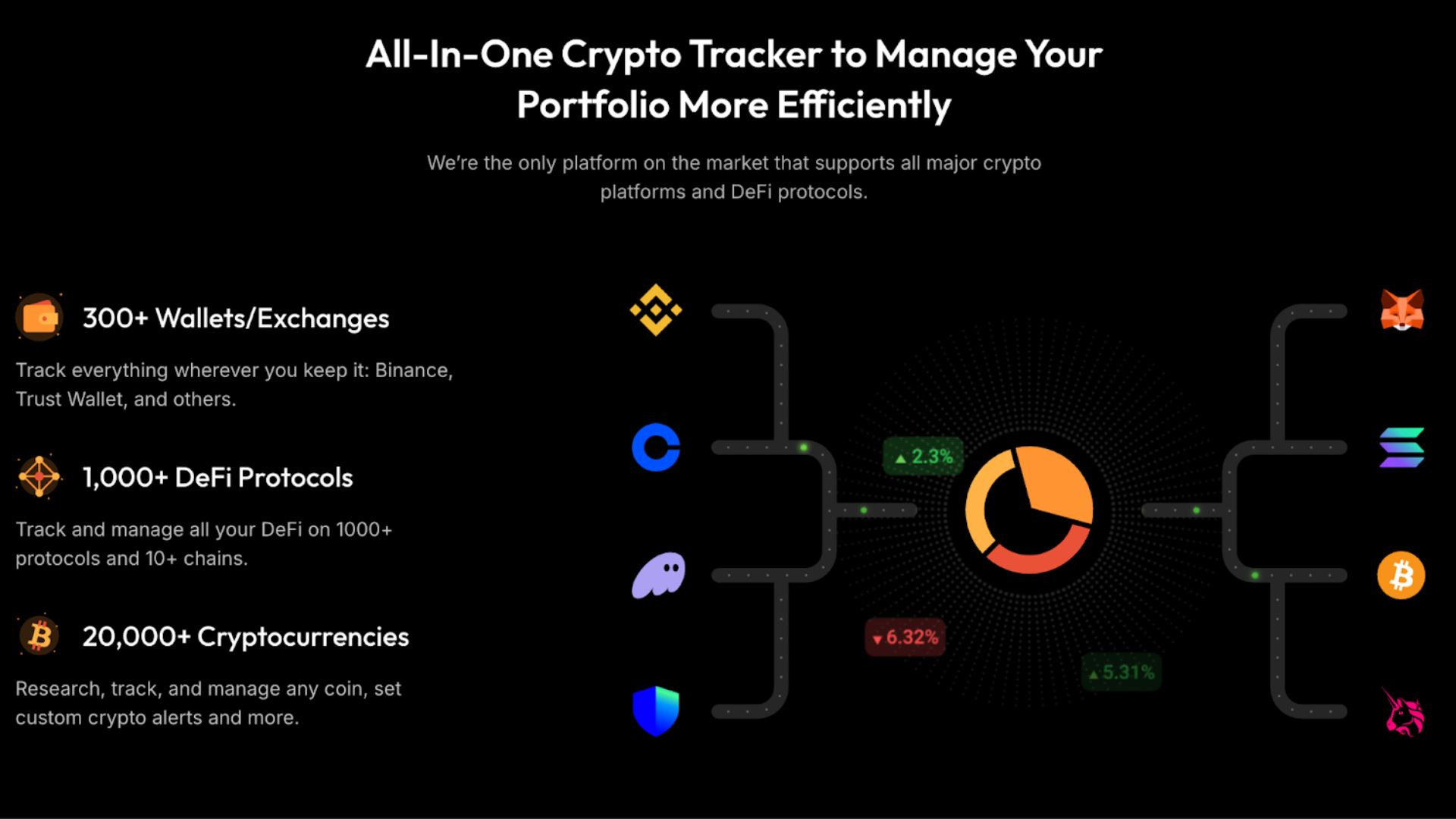
If your crypto activity goes beyond simply buying and holding, CoinStats is probably already on your radar.
The platform has become a favorite among active investors because it handles complexity surprisingly well. Whether you're managing assets across exchanges, wallets, staking platforms, or DeFi protocols, CoinStats pulls everything together into one place.
What makes it stand out isn't just the syncing. It's the depth of information available once everything is connected.
Want to see how a particular token has performed over six months? Easy. Curious about your overall profit and loss across multiple wallets? A few taps. Need a quick snapshot of portfolio risk? The built-in analytics make that possible without forcing you to build spreadsheets.
What you'll like:
Connects with hundreds of wallets and exchanges
Supports a huge range of blockchains and DeFi ecosystems
Detailed profit-and-loss tracking
Strong cross-device synchronization
Potential drawbacks:
Some of the most powerful research and analytics tools sit behind a subscription
New users may feel overwhelmed by the amount of data available
For serious crypto investors, though, that's often a feature—not a bug.
2. Delta by eToro (iOS & Android)
Not everyone keeps their investments exclusively in crypto.
Maybe you own Bitcoin, but you also hold index funds. Perhaps you've got a few tech stocks, some ETFs, and a crypto portfolio on the side. If that sounds familiar, Delta deserves a close look.
Where CoinStats focuses heavily on crypto infrastructure, Delta focuses on clarity.
The interface is polished, easy to navigate, and excellent at showing how your investments are performing over time. Instead of drowning you in metrics, it highlights the numbers most investors actually care about: gains, losses, allocation, and long-term growth.
One of its biggest strengths is bringing multiple asset classes together. Crypto, stocks, commodities, NFTs—they can all live under the same roof.
What you'll like:
Beautiful and intuitive interface
Tracks traditional investments alongside crypto
Excellent price alerts and notifications
Clear performance visualization
Potential drawbacks:
Unlimited integrations require a paid subscription
Fewer community and social features than some competitors
For investors who want a complete picture of their finances—not just their crypto holdings—Delta is hard to beat.
3. CoinMarketCap (iOS & Android)
Sometimes simpler is better.
Not everyone wants to connect wallets, authorize exchange APIs, or grant access to account data. Some investors prefer to keep everything manual, even if it requires a little extra effort.
That's where CoinMarketCap shines.
Most people know CoinMarketCap as the industry's go-to source for cryptocurrency pricing and market data. What often gets overlooked is its built-in portfolio tracker.
The concept is straightforward: enter your transactions manually, and the app calculates your holdings, portfolio allocation, and profit or loss.
No wallet connections. No API permissions. No syncing concerns.
Just your data and your records.
What you'll like:
Completely free
Massive cryptocurrency database
No need to connect exchanges or wallets
Great option for privacy-conscious users
Potential drawbacks:
Every transaction must be entered manually
Becomes less practical for active traders
For long-term investors who make only occasional trades, that tradeoff may be perfectly acceptable.
Which One Makes the Most Sense for You?
The answer depends less on the size of your portfolio and more on how you manage it.
If you're active in DeFi, staking, NFTs, and multiple chains:
Go with CoinStats. The automation alone can save countless hours, and the analytics provide insights that are difficult to replicate manually.
If you invest in both crypto and traditional assets:
Choose Delta. Having stocks, ETFs, and crypto visible in one dashboard makes portfolio management much easier.
If privacy is your top priority:
Stick with CoinMarketCap. Manual tracking isn't glamorous, but it keeps you firmly in control of your data.
One Security Rule You Should Never Ignore
A portfolio tracker should only observe your holdings—not control them.
Whenever possible, use read-only API permissions. If an app asks for trading permissions when all you want is portfolio tracking, pause and double-check what you're authorizing.
And one more thing.
No legitimate portfolio tracker will ever need your wallet's recovery phrase or private keys. Ever.
The moment an app asks for either, treat it as a red flag and walk away.
So how are you tracking your investments these days? Do you have everything consolidated into a single dashboard, or are you still hopping between exchange apps trying to piece together your total portfolio value?