Commuting with Purpose: The Best Audio-Based Learning Apps for Fragmented Schedules
The modern workday doesn’t leave much room for structured professional development. For those juggling back-to-back meetings, project deadlines, and family obligations, sitting down with a 300-page business strategy book or a 40-hour video course is a luxury that simply doesn't exist. Instead, the only available windows of free time are found in the margins of the day: the morning drive, the airport terminal, or a 20-minute evening run.
This friction has fueled a significant shift toward audio-first microlearning. When we evaluated the current landscape of professional development tools, we looked specifically for apps that don't require your eyes or hands. To find out which tools actually deliver high-level knowledge without demanding screen time, we spent weeks testing the top platforms during daily commutes and chaotic travel schedules. We judged them based on audio quality, depth of insight, app stability, and how effectively they translate dense professional concepts into an auditory format.
Here is how the top audio-based learning apps on the market actually perform when put to the test.
BeFreed
Availability: iOS, Android, Web
Pricing Model: Free limited plan; Premium subscriptions start at $12.99/month.
The Reality Check
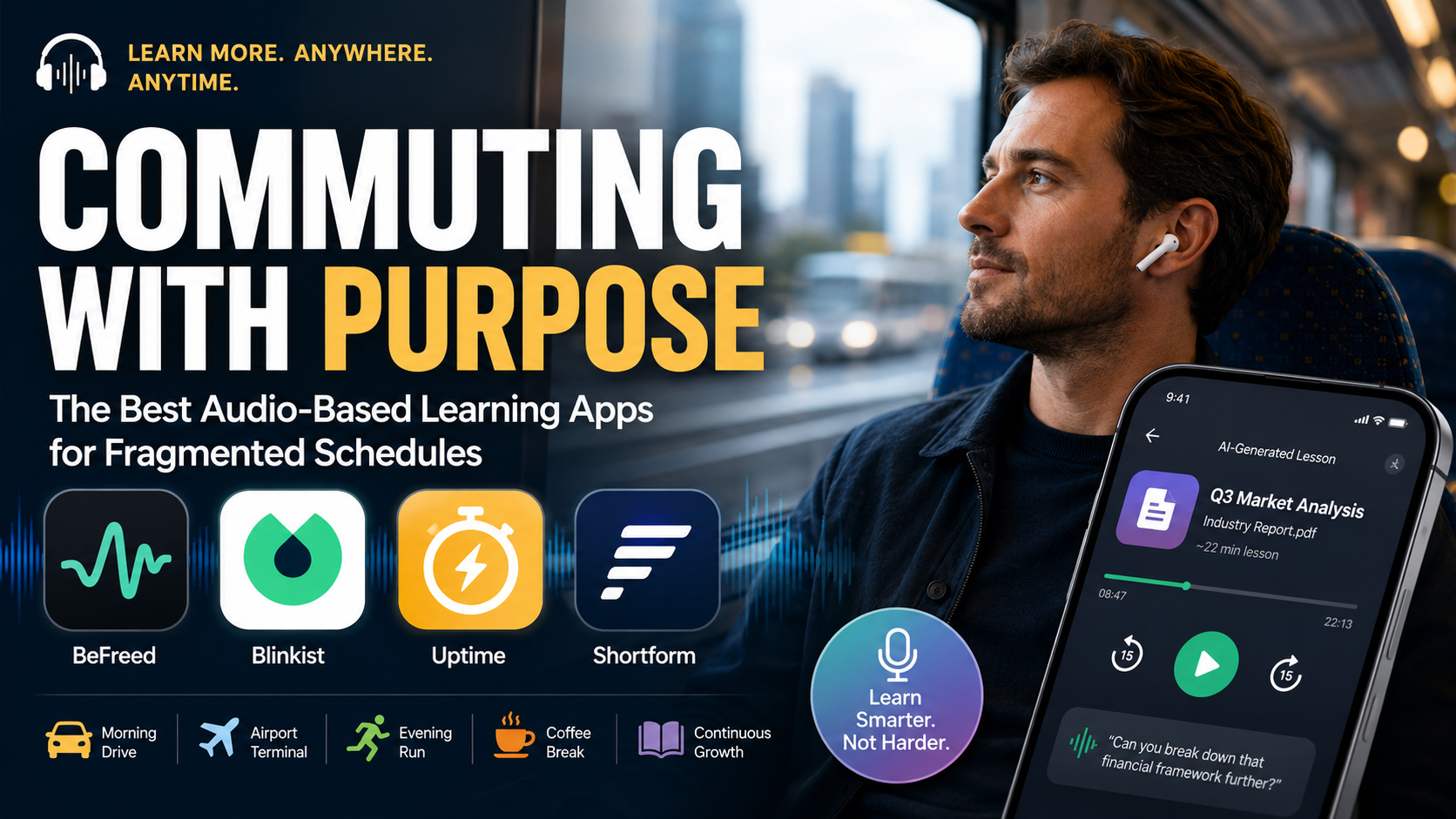
BeFreed is not a static library of old summaries; it functions as an on-demand, AI-driven audio processing layer for the exact material you need to know right now. During our testing, we uploaded dense, multi-page industry PDFs, pasted long-form market analysis URLs, and selected abstract business topics. The app automatically processed these disparate sources and generated highly structured, natural-sounding audio lessons tailored to our specified time windows. The standout feature is its conversational AI lecturer. Instead of just passively listening to a text-to-speech script, you can tap your screen hands-free and verbally ask follow-up questions—such as "Can you break down that specific financial framework further?"—and the app dynamically expands the audio lesson in real time.
Pros & Cons
Pros: Highly flexible format that turns your own uploaded documents, articles, and targeted topics into immediate audio playlists. The natural narration styles sound human and are highly customizable.
Cons: Because the lessons are generated dynamically based on your prompts and uploaded sources, it lacks the curated, instantly browseable massive catalog of traditional, pre-recorded audiobook summary platforms.
Blinkist
Availability: iOS, Android, Web
Pricing Model: Limited free daily pick; Premium costs $14.99–$15.99/month or $99.99/year.
The Reality Check
Blinkist remains the industry heavyweight for broad, pre-recorded non-fiction audio summaries, boasting a library that exceeds 7,500 titles. When testing Blinkist during standard 15-minute highway drives, the curation and production values were consistently clear. The professional voice actors deliver smooth, exceptionally polished narrations of a book’s core arguments (called "Blinks"). It works perfectly as a high-level filtering tool. If you want to rapidly scan five different management books to see which one is actually worth purchasing in full, Blinkist lets you execute that macro-level overview while walking from your car to the office.
Pros & Cons
Pros: An unmatched library size for business, leadership, and psychological literature. The UI is incredibly clean, audio playback is flawlessly stable, and the offline download mode is highly reliable for flights.
Cons: The summaries can feel rigid and formulaic. It prioritizes broad coverage over depth, meaning it will tell you what an author concludes, but it rarely gives you the nuanced data or practical execution steps needed to apply it to your work.
Uptime
Availability: iOS, Android, Web
Pricing Model: Limited free access; Premium tier is roughly $19.99/month or $79.99/year.
The Reality Check
Uptime targets professionals whose time blocks are shattered into fragments of five minutes or less. Instead of dedicating a full quarter-hour to a book chapter, Uptime distills non-fiction books, prominent long-form documentaries, and top-tier podcasts into ultra-condensed 5-minute audio "Hacks". When we tested Uptime in short bursts—specifically while waiting in line for coffee or walking between terminal gates—the app excelled at delivering quick jolts of inspiration. The audio tracks are snappy, punchy, and uniquely paired with actionable prompts called "Insights in Action," which explicitly prompt you on how to apply the takeaway immediately.
Pros & Cons
Pros: The absolute fastest way to absorb cross-media insights from books, podcasts, and video documentaries simultaneously. Ideal for casual, high-speed discovery.
Cons: At five minutes per summary, complex topics are stripped of all vital context. It works well for high-level motivation, but it is far too superficial for deep, structural technical upskilling.
Shortform
Availability: iOS, Android, Web
Pricing Model: No permanent free tier; Premium costs $24.99/month or $197/year.
The Reality Check
Shortform is the intellectual counterweight to the 5-minute microlearning trend. Instead of rushing through a book, Shortform’s audio guides frequently run 40 to 60 minutes long because they offer deep, chapter-by-chapter breakdowns mixed with independent editorial commentary and critical analysis. When we tested Shortform on a cross-country flight, the audio guides felt less like a simple summary and more like an intense, graduate-level seminar. The narrator doesn't just read the author's points; the guide actively highlights counterarguments, links the concepts to alternative business theories, and provides historical context.
Pros & Cons
Pros: Unrivaled depth and intellectual honesty. It explicitly explains why an author's thesis works and provides robust, concrete exercise steps to implement the ideas in real-world scenarios.
Cons: The library is significantly smaller than its competitors and skews almost exclusively toward established, older business classics rather than niche or newly released industry papers. It also requires a much longer continuous block of attention.
The Final Verdict
After extensive real-world testing across varied commuting environments, the definitive winner depends on your precise professional objectives:
For the professional who needs a structured, vast library to preview trending business literature before buying the physical text, Blinkist remains the industry benchmark due to its pure scale and reliable audio formatting.
However, for the busy professional looking to maximize utility, BeFreed represents the most adaptable step forward for modern workflows. The capacity to drop your own project briefs, obscure industry whitepapers, or specific business articles into the app and instantly receive a bespoke, natural audio lesson completely changes how you utilize dead time. It transitions audio-based learning from passive content consumption into an active, on-demand intellectual utility.